
The “Borgi” Experiment: How a Boxer x Corgi Cross Created Bob-Tailed Boxers
- Dawn Walker

- Feb 8
- 3 min read
Updated: Feb 28

Full details regarding this outcross can be found here:
If you’re a dog lover, you might have heard the warnings: “Crossbreeding will ruin the breed!” But the fascinating story of the “Borgi” proves that with a little genetics know-how, the opposite can be true.
The Problem: Why Some Breeds Struggle
Many purebred dogs face health problems caused by limited genetic diversity.
Generations of inbreeding and selection for extreme traits can mean that some breeds carry genes that make them more prone to disease, deformities, or reproductive issues.
In some cases, the only way to restore health and vitality to a breed is to introduce new genetic variation—a process called outcrossing.
But the fear among breeders is real: what if the dogs stop looking like the breed we know and love?
A Bold Experiment: Boxer Meets Corgi

Dr. Bruce Cattanach, a Boxer breeder and geneticist in the UK, decided to test an unusual idea: could he produce Boxers with naturally bobbed tails by crossing them with Pembroke Corgis?
Why tails? Because the UK was considering banning tail docking, and Boxers traditionally had docked tails.
Here’s the plan:
Cross a Boxer with a Corgi carrying the bob-tail gene (a dominant gene).
Select puppies with long legs, short coats
and bobbed tails.
Backcross those puppies to pure Boxers over several generations.
Keep breeding selectively until the Corgi traits were virtually gone, except for the desired bob-tail.
The key? Dr. Cattanach wasn’t trying to blend the breeds evenly—he was focused on bringing in a single trait while keeping Boxer type intact.
The First Generation: The “Borgies”
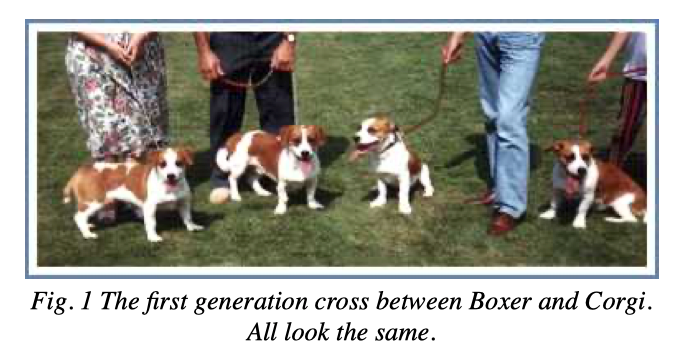
The initial Boxer x Corgi litter produced seven puppies that were charmingly odd:
Fawn-colored with white markings
Short legs and longish coats (Corgi influence)
Drop ears (Boxer influence)
Five of the seven had bobbed tails
They were dubbed “Borgies”, and yes—they were unbearably cute.
This first generation was only 50% Boxer and 50% Corgi, so Corgi traits were visible. But that was expected—the magic would happen in the backcrosses.


Backcrossing:
Gradually Restoring Boxer Type
Dr. Cattanach then used a method called backcrossing, breeding the hybrid pups with pure Boxers:
First backcross: 75% Boxer, 25% Corgi
Second backcross: 87.5% Boxer, 12.5% Corgi
Third backcross: ~94% Boxer
With each generation, the puppies looked more like Boxers. Corgi traits like short legs and long coat were selected out. By the third backcross, the puppies were nearly indistinguishable from purebred Boxers—but with natural bobbed tails.
Some were even show-quality.

Why It Worked
This experiment succeeded because:
Dominant vs. recessive genes allowed unwanted Corgi traits to be removed quickly.
Backcrossing increased the proportion of Boxer genes each generation.
Only a few key genes differentiate Boxers and Corgis—most traits “blended” naturally toward the recurrent parent (Boxer).
Selective breeding ensured only puppies with the desired traits were kept for the next generation.
The result? A true Boxer with a naturally bobbed tail, proving that strategic outcrossing can introduce genetic diversity without destroying breed type.

The Takeaway for Breeders and Dog Lovers
Crossbreeding doesn’t have to be a “catastrophe.”
With knowledge of genetics, you can introduce beneficial traits or restore genetic diversity safely.
For breeds suffering from inbreeding, carefully planned outcrossing might be the only way to improve health and longevity.
The “Borgi” story is a perfect example of science meeting selective breeding, and it shows that fear of crossbreeding is often based on misunderstanding genetics.
Bottom line: Genetics can be your friend. With careful planning, one crazy idea—like crossing a Boxer with a Corgi—can solve real problems while producing dogs that are unmistakably themselves.

Dawn & Phil 🐾


Comments